
Nature-
Laughter might be thought of as an audible expression or appearance of excitement, an inward feeling of joy and happiness. It may ensue from jokes, tickling, and other stimuli completely unrelated to psychological state, such as nitrous oxide. One group of researchers speculated that noises from infants as early as 17 days old may be vocal laughing sounds or laughter, however the weight of the evidence supports its appearance at 15 weeks to four months of age.
Laughter researcher Robert Provine said: "Laughter is a mechanism everyone has; laughter is part of universal human vocabulary. There are thousands of languages, hundreds of thousands of dialects, but everyone speaks laughter in pretty much the same way." Babies have the ability to laugh before they ever speak. Children who are born blind and deaf still retain the ability to laugh.
Provine argues that "Laughter is primitive, an unconscious vocalization." Provine argues that it probably is genetic. In a study of the "Giggle Twins", two happy twins who were separated at birth and only reunited 43 years later, Provine reports that "until they met each other, neither of these exceptionally happy ladies had known anyone who laughed as much as they did." They reported this even though they both had been brought together by their adoptive parents, who they indicated were "undemonstrative and dour." He indicates that the twins "inherited some aspects of their laugh sound and pattern, readiness to laugh, and maybe even taste in humor."
Norman Cousins developed a recovery program incorporating megadoses of Vitamin C, along with a positive attitude, love, faith, hope, and laughter induced by Marx Brothers films. "I made the joyous discovery that ten minutes of genuine belly laughter had an anesthetic effect and would give me at least two hours of pain-free sleep," he reported. "When the pain-killing effect of the laughter wore off, we would switch on the motion picture projector again and not infrequently, it would lead to another pain-free interval."
Scientists have noted the similarity in forms of laughter induced by tickling among various primates, which suggests that laughter derives from a common origin among primate species.
A very rare neurological condition has been observed whereby the sufferer is unable to laugh out loud, a condition known as aphonogelia.

Health-
Neurophysiology indicates that laughter is linked with the activation of the ventromedialprefrontal cortex, that produces endorphins. Scientists have shown that parts of the limbic system are involved in laughter. This system is involved in emotions and helps us with functions necessary for humans' survival. The structures in the limbic system that are involved in laughter: the hippocampus and the amygdala.
The December 7, 1984, Journal of the American Medical Association describes the neurological causes of laughter as follows:
"Although there is no known 'laugh center' in the brain, its neural mechanism has been the subject of much, albeit inconclusive, speculation. It is evident that its expression depends on neural paths arising in close association with the telencephalic and diencephalic centers concerned with respiration. Wilson considered the mechanism to be in the region of the mesial thalamus, hypothalamus, and subthalamus. Kelly and co-workers, in turn, postulated that the tegmentum near the periaqueductal grey contains the integrating mechanism for emotional expression. Thus, supranuclear pathways, including those from the limbic system that Papez hypothesised to mediate emotional expressions such as laughter, probably come into synaptic relation in the reticular core of the brain stem. So while purely emotional responses such as laughter are mediated by subcortical structures, especially the
hypothalamus, and are stereotyped, the cerebral cortex can modulate or suppress them."
A link between laughter and healthy function of blood vessels was first reported in 2005 by researchers at the University of Maryland Medical Center with the fact that laughter causes the dilatation of the inner lining of blood vessels, theendothelium, and increases blood flow. Drs. Michael Miller (University of Maryland) and William Fry (Stanford), theorize that beta-endorphin like compounds released by the hypothalamus activate receptors on the endothelial surface to release nitric oxide, thereby resulting in dilation of vessels. Other cardioprotective properties of nitric oxide include reduction of inflammation and decreased platelet aggregation.
Laughter has proven beneficial effects on various other aspects of biochemistry. It has been shown to lead to reductions in stress hormones such as cortisol and epinephrine. When laughing the brain also releases endorphins that can relieve some physical pain. Laughter also boosts the number of antibody-producing cells and enhances the effectiveness of T-cells, leading to a stronger immune system. A 2000 study found that people with heart disease were 40 percent less likely to laugh and be able to recognize humor in a variety of situations, compared to people of the same age without heart disease.

Nervous Laughter-
Nervous laughter is laughter evoked from an audience's expression of embarrassment, alarm, discomfort or confusion, rather than amusement. Nervous laughter is usually less robust in expression than "a good belly laugh", and may be combined with confused glances or awkward silence on the part of others in the audience. Nervous laughter is considered analogous to a courtesy laugh, which may be rendered by more of a conscious effort in an attempt to move a situation along more quickly, especially when the comedian is pausing for laughter.
Nervous laughter is a physical reaction to stress, tension, confusion, or anxiety. Neuroscientist Vilayanur S. Ramachandranstates "We have nervous laughter because we want to make ourselves think what horrible thing we encountered isn't really as horrible as it appears, something we want to believe." Those are the most embarrassing times, too, naturally. Psychologist and neuroscientist Robert Provine, from the University of Maryland, studied over 1,200 "laughter episodes" and determined that 80% of laughter isn't a response to an intentional joke.
Unhealthy or "nervous" laughter comes from the throat. This nervous laughter is not true laughter, but an expression of tension and anxiety. Instead of relaxing a person, nervous laughter tightens them up even further. Much of this nervous laughter is produced in times of high emotional stress, especially during times where an individual is afraid they might harm another person in various ways, such as a person's feelings or even physically.
People laugh when they need to project dignity and control during times of stress and anxiety. In these situations, people usually laugh in a subconscious attempt to reduce stress and calm down, however, it often works otherwise. Nervous laughter is often considered fake laughter and even heightens the awkwardness of the situation.
People may laugh nervously when exposed to stress due to witnessing others' pain. For instance, in Stanley Milgram's obedience experiment, subjects ("teachers") were told to shock "learners" every time the learners answered a question incorrectly. Although the "learners" were not actually shocked, the subjects believed they were. As they were going through the study, many of the "subjects showed signs of extreme tension and conflict". Milgram observed some subjects laughing nervously when they heard the "learners'" false screams of pain. In A Brief Tour of Human Consciousness, neuroscientist V.S. Ramachandran suggests that laughter is used as a defense mechanism used to guard against overwhelming anxiety. Laughter often diminishes the suffering associated with a traumatic event.
If the individual is shy or bashful and appears nervous when talking, he or she is likely to exhibit nervous laughter. Individuals who are shy and introverted who find themselves the center of conversational attention often become “giddy” with nervous laughter; this is a subconscious response caused by the brain over-thinking due to social anxiety or inexperience.

Laughter in Animals-
Chimpanzees, gorillas, bonobos and orangutans show laughter-like vocalizations in response to physical contact such as wrestling, play chasing or tickling. This is documented in wild and captive chimpanzees. Chimpanzee laughter is not readily recognizable to humans as such, because it is generated by alternating inhalations and exhalations that sound more like breathing and panting. It sounds similar to screeching. The differences between chimpanzee and human laughter may be the result of adaptations that have evolved to enable human speech. One study[citation needed] analyzed sounds made by human babies and bonobos when tickled. It found that although the bonobo’s laugh was a higher frequency, the laugh followed the same sonographic pattern of human babies to include as similar facial expressions. Humans and chimpanzees share similar ticklish areas of the body such as the armpits and belly.
Research has noted the similarity in forms of laughter among humans and apes (chimpanzees, bonobos, gorillas, orangutans) when tickled, suggesting that laughter derived from a common origin among primate species, and thereforeevolved prior to the origin of humans.
Rats emit long, 50-kHz ultrasonic calls that are induced during rough and tumble play, and when tickled by humans. The vocalization is described as distinct "chirping". Like humans, rats have "tickle skin", areas of the body that generate greater laughter responses than others. Rats that laugh the most also play the most and prefer to spend more time with other laughing rats. It has been reported that there is no decline in the tendency to laugh and respond to tickle skin as rats age, however, it has also been reported that in females, brain maturation after puberty appears to redefine tickling as aversive, leading to avoidance rather than appetitive responses.Further studies show that rats chirp when wrestling one another, before receiving morphine, or when mating. The sound has been interpreted as an expectation of something rewarding.High frequency ultrasonic vocalizations are important in rat communication and function to elicit approach behavior in the recipient.
The initial goal of research by Jaak Panksepp and Jeff Burgdorf was to track the biological origins of how the brain processes emotions and social behavior. They compared rat vocalizations during social interactions to the joy and laughter commonly experienced by children in social play. They concluded that the 50-kHz rat vocalizations might reflect positive affective states (feelings or emotions), analogous to those experienced by children laughing during social play.
More recent studies have investigated the emotional states of rats after being tickled. An animal's optimism or pessimism can be assessed by cognitive bias studies. After being tickled, rats are more optimistic, indicating the interaction invokes a positive affective state. Furthermore, rats self-administer playback of the 50-kHz trill calls and avoid playback of 22-kHz calls.
When rats are given naloxone (an opioid antagonist), tickling no longer evokes the 50-kHz vocalisation which indicates that the rewarding properties of tickling are modulated by endogenous opioids.
Dogs sometimes pant in a manner that sounds like a human laugh. By analyzing the pant using a sonograph, this pant varies with bursts of frequencies. When this vocalization is played to dogs in a shelter setting, it can initiate play, promote pro-social behavior, and decrease stress levels. One study compared the behaviour of 120 dogs with and without exposure to a recorded "dog-laugh". Playback reduced stress-related behaviors, increased tail wagging, the display of a "play-face" when playing was initiated, and pro-social behavior such as approaching and lip licking.
Laughter Yoga-
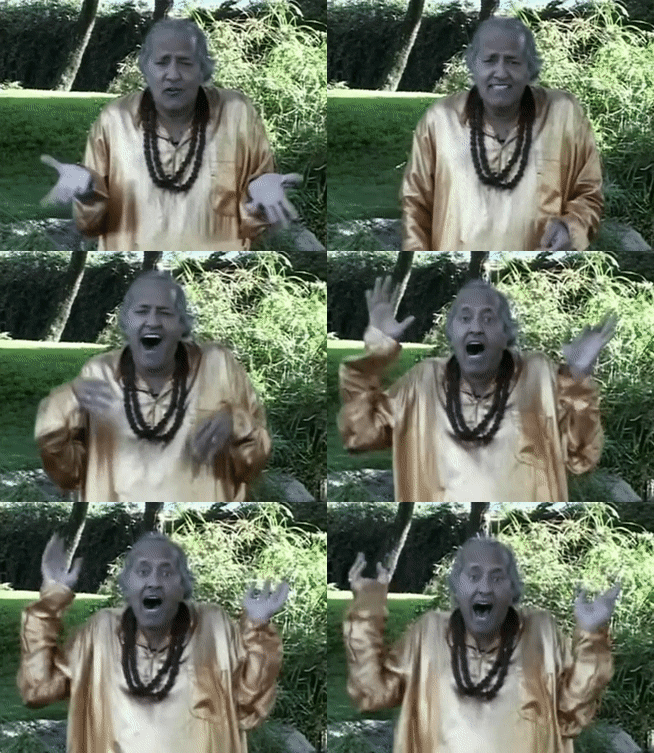
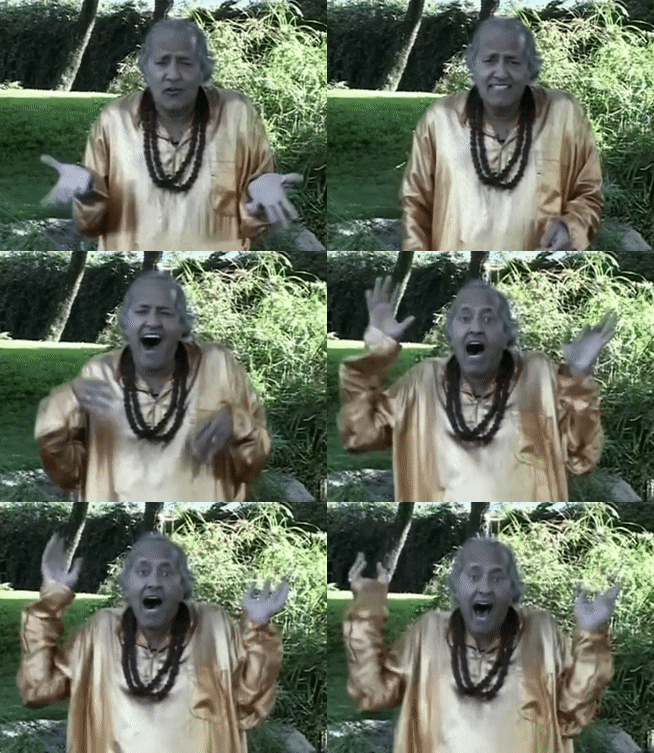
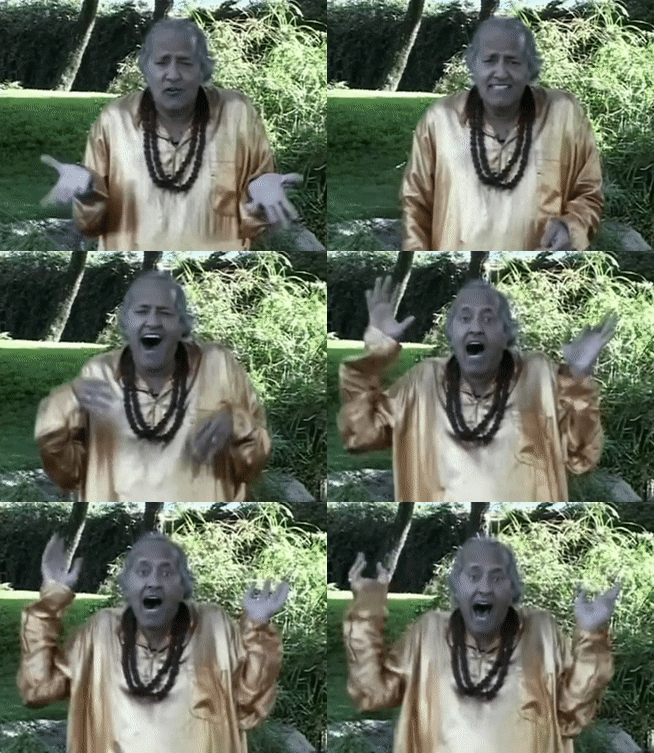
Laughter yoga was made popular as an exercise routine developed by Indian physician Madan Kataria, who writes about the practice in his 2002 book Laugh For No Reason.
In the mid-1990s, laughter yoga was practiced in the early mornings in open parks, primarily by groups of older people. Later, a more formal version was created and popularized as "Laughter Clubs". Kataria's first Laughter Yoga Club began on 13 March 1995 in Mumbai, with five people in a local public park. The concept rapidly spread worldwide, and as of 2011, there were more than 8,000 Laughter Clubs in 100 countries. Each group is run by a "Laugh Captain" and operates independently.
Laughter is easily stimulated in a group when combined with eye contact, 'childlike playfulness' and laughter exercises. Fake laughter quickly becomes real. Laughter Yoga brings more oxygen to the body and brain by incorporating yogic breathing which results in deep diaphragmatic breathing.
Anyone can laugh without needing to rely on humor, jokes or comedy. Laughter is initially simulated as a physical exercise while maintaining eye contact with others in the group and promoting childlike playfulness. In most cases this soon leads to real and contagious laughter. Laughter yoga is the only technique that allows adults to achieve sustained hearty laughter without involving cognitive thought. It bypasses the intellectual systems that normally act as a brake on natural laughter.
Laughter yoga sessions start with gentle warm-up techniques which include stretching, chanting, clapping and body movement. These help break down inhibitions and develop feelings of 'childlike playfulness'. Breathing exercises are used to prepare the lungs for laughter, followed by a series of ‘laughter exercises’ that combine the method of acting and visualization techniques with playfulness. These exercises, when combined with the strong social dynamics of group behavior, lead to prolonged and hearty unconditional laughter. Laughter exercises are interspersed with breathing exercises. Twenty minutes of laughter is sufficient to develop full physiological benefits.
A laughter yoga session may finish with "Laughter Meditation". This is a session of unstructured laughter whereby participants sit or lie down and allow natural laughter to flow from within "like a fountain".

Causes of laughter-
Common causes for laughter are sensations of joy and humor; however, other situations may cause laughter as well.
A general theory that explains laughter is called the relief theory. Sigmund Freudsummarized it in his theory that laughter releases tension and "psychic energy". This theory is one of the justifications of the beliefs that laughter is beneficial for one's health. This theory explains why laughter can be used as a coping mechanism when one is upset, angryor sad.
Philosopher John Morreall theorizes that human laughter may have its biological origins as a kind of shared expression of relief at the passing of danger. Friedrich Nietzsche, by contrast, suggested laughter to be a reaction to the sense of existential loneliness and mortality that only humans feel.
For example: a joke creates an inconsistency and the audience automatically try to understand what the inconsistency means; if they are successful in solving this 'cognitive riddle' and they realize that the surprise was not dangerous, theylaugh with relief. Otherwise, if the inconsistency is not resolved, there is no laugh, as Mack Sennett pointed out: "when the audience is confused, it doesn't laugh." This is one of the basic laws of a comedian, referred to "exactness". It is important to note that sometimes the inconsistency may be resolved and there may still be no laugh.Because laughter is a social mechanism, an audience may not feel as if they are in danger, and the laugh may not occur. In addition, the extent of the inconsistency (and aspects of it timing and rhythm) has to do with the amount of danger the audience feels, and how hard or long they laugh.
Laughter can also be brought on by tickling. Although most people find it unpleasant, being tickled often causes heavy laughter, thought to be an (often uncontrollable) reflex of the body.

Ridiculousness-
The ridiculous is that which is highly incongruous or inferior, sometimes deliberately so to make people laugh or get their attention, and sometimes unintended so as to be considered laughable and earn or provoke ridicule and derision. It comes from the 1540s Latino "ridiculosus" meaning "laughable", from "ridiculus" meaning "that which excites laughter", and from "ridere" meaning "to laugh". "Ridiculous" is an adjective describing "the ridiculous".
In common usage, "ridiculousness" is used as a synonym for absurdity or nonsense.From a historical and technical viewpoint, "absurdity" is associated with invalid argumentation and reasoning, "nonsense" with semantics and meaning, while "ridiculous" is most associated with laughter, superiority, deformity, and incongruity.Reductio ad absurdum is a valid method of argument, while reductio ad ridiculum is invalid. Argument by invective declaration of ridiculous is invalid, while arguments involving declarations of nonsense may summarize a cogent semantic problem with lack or meaning or ambiguity.
Historically, the ridiculous was central to initial theories of humor and laughter as first put forth by philosopher Thomas Hobbes. It was used in psychosocial power struggles in the European court by reducing opponents to the ridiculous using ridicule. It is currently used in the theory of humor to create laughter, shock, parody, or satire. Reactions to the ridiculous have been studied in psychology for its effects on memory, attention, and attitude in social hierarchies. These studies have been applied to the theory of advertisement regarding attention, memory, and alleviation of preexisting negative attitudes toward products. The ridiculous is often contrasted with the sublime, one of extreme inferiority, the other of extreme superiority, and often one can suddenly move from one extreme state to the other.